 |
The SKIRT project
advanced radiative transfer for astrophysics
|
|
The SKIRT project
advanced radiative transfer for astrophysics
|
As described in Subprojects and modules, the code for the SKIRT project is organized into a set of modules, grouped into the SMILE, SKIRT, MakeUp, and Docs subprojects. Each module is built as a separate static library (or, for a few of them, an executable), and a module may depend on other modules, meaning that its code includes header files from those other modules and links against their libraries.
These dependencies form a strict hierarchy: there are no two-way or circular dependencies between modules, and this is enforced rather than merely encouraged. When adjusting or extending the code, it is important not to inadvertently introduce a new dependency that would close a cycle, for example by having a lower-level module call back into a higher-level one. If you are unsure whether a change you are considering would introduce such a cycle, consult the tables below.
The tables list, for every module in the project, the other modules it depends on, split into:
A module that does not appear as a direct or indirect dependency of a second module can safely be assumed to not be needed by, and must not be made to depend on, that second module.
| Module | Direct dependencies | Indirect dependencies |
|---|---|---|
build | fundamentals | none |
fundamentals | none | none |
schema | fundamentals | none |
serialize | fundamentals, schema | none |
wizard | fundamentals, schema, serialize | none |
smiletool | build, fundamentals, schema, serialize | none |
shapes | build, fundamentals, schema, serialize | none |
| Module | Direct dependencies | Indirect dependencies |
|---|---|---|
fitsio | none | none |
voro | none | none |
tetgen | none | none |
mpi | fundamentals | none |
utils | fundamentals | none |
tools | fitsio, fundamentals, mpi, schema, utils | none |
field | fundamentals, tools, utils | fitsio, mpi, schema |
grain | fundamentals, tools, utils | fitsio, mpi, schema |
sed | fundamentals, tools, utils | fitsio, mpi, schema |
geometry | fundamentals, mpi, tools, utils, voro | fitsio, schema |
wavelength | fundamentals, tools, utils | fitsio, mpi, schema |
source | field, fundamentals, geometry, mpi, sed, tools, utils, wavelength | fitsio, schema, voro |
material | fundamentals, grain, mpi, tools, utils, wavelength | fitsio, schema |
medium | field, fundamentals, geometry, material, mpi, tetgen, tools, utils, wavelength | fitsio, grain, schema, voro |
instrument | fundamentals, mpi, tools, utils, wavelength | fitsio, schema |
probe | fundamentals, geometry, grain, instrument, material, medium, mpi, source, tools, utils, wavelength | field, fitsio, schema, sed, tetgen, voro |
simulation | build, field, fundamentals, geometry, grain, instrument, material, medium, mpi, probe, schema, sed, serialize, source, tools, utils, wavelength | fitsio, tetgen, voro |
| Module | Direct dependencies | Indirect dependencies |
|---|---|---|
main | build, fundamentals, wizard | schema, serialize |
| Module | Direct dependencies | Indirect dependencies |
|---|---|---|
doxstyle | fundamentals | none |
The diagram below shows a summary of the information in the tables above, restricted to the SKIRT modules themselves plus the four SMILE modules they reach into directly. An arrow points from a module down to a module it depends on. To limit the number of arrows, an arrow that is already implied by a chain of other arrows is omitted. In other words, only the transitive reduction is shown.
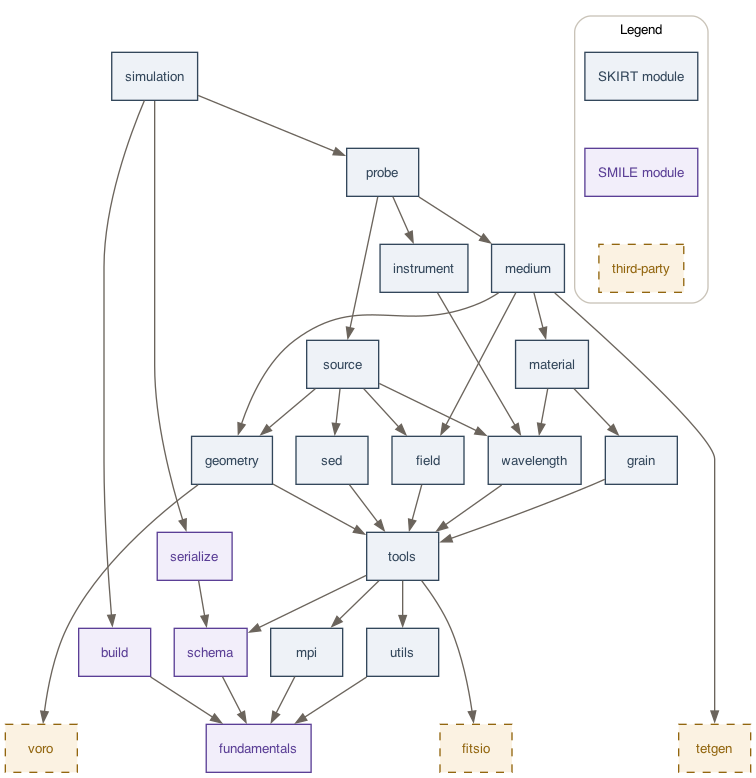
There is an intimate bidirectional dependency between the medium system and the spatial grid classes. The medium system owns and uses the simulation's spatial grid to construct and manage the per-cell medium state. Vice versa, spatial grid setup often requires access to the medium components to determine the grid structure (for example, based on medium density). To avoid forbidden cyclic dependencies between modules, the spatial grid classes are included in the medium module. Resolving this issue would require a major redesign.