 |
The SKIRT project
advanced radiative transfer for astrophysics
|
|
The SKIRT project
advanced radiative transfer for astrophysics
|
#include <LightCurveInstrument.hpp>
Public Member Functions | |
| void | detect (PhotonPacket *pp) override |
| Public Member Functions inherited from TimeInstrument | |
| TimeGrid * | timeGrid () const |
| Public Member Functions inherited from ApertureInstrument | |
| double | radius () const |
| Public Member Functions inherited from DistantInstrument | |
| double | azimuth () const |
| Direction | bfkobs (const Position &bfr) const override |
| Direction | bfky (const Position &bfr) const override |
| void | determineSameObserverAsPreceding (const Instrument *precedingInstrument) override |
| double | distance () const |
| double | inclination () const |
| double | roll () const |
| Public Member Functions inherited from Instrument | |
| void | flush () |
| string | instrumentName () const |
| const WavelengthGrid * | instrumentWavelengthGrid () const |
| bool | isSameObserverAsPreceding () const |
| string | itemName () const override |
| int | numScatteringLevels () const |
| bool | recordComponents () const |
| bool | recordPolarization () const |
| bool | recordStatistics () const |
| WavelengthGrid * | wavelengthGrid () const |
| void | write () |
| Public Member Functions inherited from SimulationItem | |
| template<class T> | |
| T * | find (bool setup=true) const |
| template<class T> | |
| T * | interface (int upLevels, int downLevels, bool setup) const |
| void | setup () |
| string | typeAndName () const |
| Public Member Functions inherited from Item | |
| Item (const Item &)=delete | |
| virtual | ~Item () |
| void | addChild (Item *child) |
| const vector< Item * > & | children () const |
| virtual void | clearItemListProperty (const PropertyDef *property) |
| void | destroyChild (Item *child) |
| virtual bool | getBoolProperty (const PropertyDef *property) const |
| virtual vector< double > | getDoubleListProperty (const PropertyDef *property) const |
| virtual double | getDoubleProperty (const PropertyDef *property) const |
| virtual string | getEnumProperty (const PropertyDef *property) const |
| virtual int | getIntProperty (const PropertyDef *property) const |
| virtual vector< Item * > | getItemListProperty (const PropertyDef *property) const |
| virtual Item * | getItemProperty (const PropertyDef *property) const |
| virtual string | getStringProperty (const PropertyDef *property) const |
| int | getUtilityProperty (string name) const |
| virtual void | insertIntoItemListProperty (const PropertyDef *property, int index, Item *item) |
| Item & | operator= (const Item &)=delete |
| Item * | parent () const |
| virtual void | removeFromItemListProperty (const PropertyDef *property, int index) |
| virtual void | setBoolProperty (const PropertyDef *property, bool value) |
| virtual void | setDoubleListProperty (const PropertyDef *property, vector< double > value) |
| virtual void | setDoubleProperty (const PropertyDef *property, double value) |
| virtual void | setEnumProperty (const PropertyDef *property, string value) |
| virtual void | setIntProperty (const PropertyDef *property, int value) |
| virtual void | setItemProperty (const PropertyDef *property, Item *item) |
| virtual void | setStringProperty (const PropertyDef *property, string value) |
| void | setUtilityProperty (string name, int value) |
| virtual string | type () const |
Protected Member Functions | |
| LightCurveInstrument () | |
| void | setupSelfBefore () override |
| Protected Member Functions inherited from TimeInstrument | |
| TimeInstrument () | |
| void | setupSelfBefore () override |
| Protected Member Functions inherited from ApertureInstrument | |
| ApertureInstrument () | |
| bool | isInsideAperture (PhotonPacket *pp) const |
| Protected Member Functions inherited from DistantInstrument | |
| DistantInstrument () | |
| Protected Member Functions inherited from Instrument | |
| Instrument () | |
| ~Instrument () | |
| FluxRecorder * | instrumentFluxRecorder () |
| void | setSameObserverAsPreceding () |
| void | setupSelfAfter () override |
| Protected Member Functions inherited from SimulationItem | |
| SimulationItem () | |
| virtual bool | offersInterface (const std::type_info &interfaceTypeInfo) const |
| Protected Member Functions inherited from Item | |
| Item () | |
Private Types | |
| using | BaseType |
| using | ItemType |
Friends | |
| class | ItemRegistry |
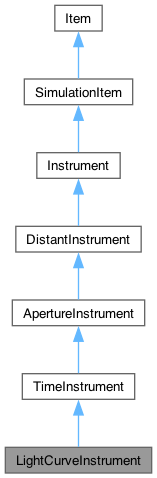
A LightCurveInstrument object represents a distant instrument with an optional circular aperture that records the spatially integrated flux density for each time lag interval and outputs a light curve text column file.
Although the recorded light curve is spectrally integrated, the instrument still requires a wavelength grid to determine its spectral response. Most often, the wavelength grid is used to simply limit the spectral range of the recorded photons, but it is also possible to specify an arbitrary response curve. Here are a few possibilities:
|
inlineprotected |
Default constructor for concrete Item subclass LightCurveInstrument: "a distant instrument that outputs the spatially integrated flux density as a light curve".
|
overridevirtual |
This function simulates the detection of a photon packet by the instrument. It verifies that the arriving photon packet projects within the aperture and then calls the detect() function of the FluxRecorder instance associated with this instrument.
Implements Instrument.
|
overrideprotectedvirtual |
This function configures the FluxRecorder instance associated with this instrument.
Reimplemented from ApertureInstrument.