 |
The SKIRT project
advanced radiative transfer for astrophysics
|
|
The SKIRT project
advanced radiative transfer for astrophysics
|
#include <AdaptiveMeshSnapshot.hpp>
Public Member Functions | |
| AdaptiveMeshSnapshot () | |
| ~AdaptiveMeshSnapshot () | |
| void | addNeighbors () |
| int | cellIndex (Position bfr) const |
| std::unique_ptr< PathSegmentGenerator > | createPathSegmentGenerator () const |
| double | density (int m) const override |
| double | density (Position bfr) const override |
| double | diagonal (int m) const |
| Box | extent () const override |
| Box | extent (int m) const |
| Position | generatePosition () const override |
| Position | generatePosition (int m) const override |
| void | getEntities (EntityCollection &entities, Position bfr) const override |
| void | getEntities (EntityCollection &entities, Position bfr, Direction bfk) const override |
| double | mass () const override |
| int | numEntities () const override |
| Position | position (int m) const override |
| void | readAndClose () override |
| void | setExtent (const Box &extent) |
| double | volume (int m) const override |
| Public Member Functions inherited from Snapshot | |
| Snapshot () | |
| virtual | ~Snapshot () |
| double | age (int m) const |
| double | bias (int m) const |
| void | close () |
| double | currentMass (int m) const |
| bool | hasAge () const |
| bool | hasBias () const |
| bool | hasCurrentMass () const |
| bool | hasInitialMass () const |
| bool | hasMagneticField () const |
| bool | hasMetallicity () const |
| bool | hasParameters () const |
| bool | hasTemperature () const |
| bool | hasVelocity () const |
| bool | hasVelocityDispersion () const |
| bool | holdsNumber () const |
| void | importBias () |
| void | importBox () |
| void | importCurrentMass () |
| void | importMagneticField () |
| void | importMass () |
| void | importMassDensity () |
| void | importMetallicity () |
| void | importNumber () |
| void | importNumberDensity () |
| void | importParameters (const vector< SnapshotParameter > ¶meters) |
| void | importPosition () |
| void | importSize () |
| void | importTemperature () |
| void | importVelocity () |
| void | importVelocityDispersion () |
| double | initialMass (int m) const |
| Vec | magneticField (int m) const |
| Vec | magneticField (Position bfr) const |
| double | metallicity (int m) const |
| double | metallicity (Position bfr) const |
| void | open (const SimulationItem *item, string filename, string description) |
| void | parameters (int m, Array ¶ms) const |
| void | parameters (Position bfr, Array ¶ms) const |
| void | setCoordinateSystem (CoordinateSystem coordinateSystem) |
| void | setMassDensityPolicy (double multiplier, double maxTemperature, bool useMetallicity) |
| void | setNeedGetEntities () |
| double | SigmaX () const |
| double | SigmaY () const |
| double | SigmaZ () const |
| double | temperature (int m) const |
| double | temperature (Position bfr) const |
| void | useColumns (string columns) |
| Vec | velocity (int m) const |
| Vec | velocity (Position bfr) const |
| double | velocityDispersion (int m) const |
| double | volume () const |
Protected Member Functions | |
| const Array & | properties (int m) const override |
| Protected Member Functions inherited from Snapshot | |
| int | ageIndex () const |
| int | biasIndex () const |
| int | boxIndex () const |
| void | calculateDensityAndMass (Array &rhov, Array &cumrhov, double &mass) |
| int | currentMassIndex () const |
| int | densityIndex () const |
| bool | hasMassDensityPolicy () const |
| TextInFile * | infile () |
| int | initialMassIndex () const |
| Log * | log () const |
| void | logMassStatistics (int numIgnored, double totalOriginalMass, double totalMetallicMass, double totalEffectiveMass) |
| int | magneticFieldIndex () const |
| virtual double | massForAveraging (int m) const |
| int | massIndex () const |
| double | maxTemperature () const |
| int | metallicityIndex () const |
| double | multiplier () const |
| bool | needGetEntities () const |
| int | numParameters () const |
| int | parametersIndex () const |
| int | positionIndex () const |
| Random * | random () const |
| void | setContext (const SimulationItem *item) |
| int | sizeIndex () const |
| int | temperatureIndex () const |
| Units * | units () const |
| bool | useMetallicity () const |
| bool | useTemperatureCutoff () const |
| int | velocityDispersionIndex () const |
| int | velocityIndex () const |
Private Attributes | |
| vector< Node * > | _cells |
| Array | _cumrhov |
| double | _eps |
| Box | _extent |
| double | _mass |
| Array | _rhov |
| Node * | _root |
Friends | |
| class | MySegmentGenerator |
Additional Inherited Members | |
| Public Types inherited from Snapshot | |
| enum class | CoordinateSystem { CARTESIAN , CYLINDRICAL , SPHERICAL } |
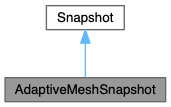
An AdaptiveMeshSnapshot object represents a three-dimensional Adaptive Mesh Refinement (AMR) grid and offers several related interrogation facilities. As implemented by this class, an adaptive mesh recursively partitions a cuboidal spatial domain into cuboidal (sub)cells. In contrast to an octree, which has a fixed 2x2x2 subdivision scheme, an adaptive mesh uses an arbitrary scheme that can (and must) be specified for each subdivision seperately. As a result, an adaptive mesh can provide high resolution (i.e. small cells) in areas where it matters, without consuming memory in areas where the resolution can be lower, in a very flexible manner.
The primary objective of the AdaptiveMeshSnapshot class is to represent snapshot data produced by a hydrodynamical simulation and imported from a column text file, defining a primary source or a transfer medium distribution. To support this use case, the class is based on the Snapshot class; it uses the facilities offered there to configure and help read the snapshot data, and it implements all functions in the general Snapshot public interface. In addition it offers functionality that is specific to this snapshot type, such as, for example, the requirement to configure the spatial extent of the domain. A client should employ the default AdaptiveMeshSnapshot constructor and configure the snapshot object as described in the Snapshot class header.
Additionally, once a snapshot has been imported, the adaptive mesh defined by the snapshot can in some cases also be used to discretize the spatial domain as a basis for the radiative transfer simulation itself. To support this use case, the class offers the capability to trace a linear path through the adaptive mesh.
Once an AdaptiveMeshSnapshot object has been constructed and fully configured, its data is no longer modified. Consequently all getters are re-entrant.
The adaptive mesh data structure is organized in a tree. Each tree node represents a cubodial portion of the domain, called its extent. The root node's extent is the complete domain. A nonleaf node distributes its extent over its child nodes using a regular linear grid. The number of subdivisions is defined separately for each node and can differ for each spatial dimension. A leaf node represents a cell in which physical quantities are considered to be constant. Collectively the leaf nodes form a partition of the domain, i.e. their extents cover the complete domain without overlapping one another.
The cells in this three-dimensional data structure can be arranged in a linear sequence using Morton ordering. This ordering is obtained by performing a depth-first traversal of the tree, where each nonleaf node outputs its children in the order x-first, then y, then z.
When reading an adaptive mesh snapshot from a text column input file, each line in the file describes a particular tree node (nonleaf or leaf), and the lines are given in Morton order. Specifically, each line in the file can be one of the following types:
Note that the input file does not include the physical extent of the domain; this information must be provided as part of the user configuration for the snapshot.
Below is an example of an adaptive mesh import file. For illustrative purposes:
# Example adaptive mesh import data file
#
! 4 3 1
 0 0.50 0.50
 1 1.50 0.50
 2 2.50 0.50
 3 3.50 0.50
 4 0.50 1.50
 5 1.50 1.50
! 2 2 1
 6 2.25 1.25
 7 2.75 1.25
 8 2.25 1.75
! 2 2 1
 9 2.63 1.63
10 2.88 1.63
11 2.63 1.88
12 2.88 1.88
! 2 2 1
13 3.25 1.25
14 3.75 1.25
15 3.25 1.75
16 3.75 1.75
17 0.50 2.50
18 1.50 2.50
! 2 2 1
19 2.25 2.25
20 2.75 2.25
21 2.25 2.75
22 2.75 2.75
! 2 2 1
23 3.25 3.25
24 3.75 3.25
25 3.25 3.75
26 3.75 3.75
| AdaptiveMeshSnapshot::AdaptiveMeshSnapshot | ( | ) |
The default constructor initializes the snapshot in an invalid state; see the description of the required calling sequence in the Snapshot class header.
| AdaptiveMeshSnapshot::~AdaptiveMeshSnapshot | ( | ) |
The destructor releases any data structures allocated by this class.
| void AdaptiveMeshSnapshot::addNeighbors | ( | ) |
This function adds neighbor information to all leaf nodes in the adaptive mesh. If should be called after the readAndClose() function has completed its operation, and before the createPathSegmentGenerator() function is invoked. Specifically, the function causes each leaf node to remember its most likely neighbor at each of its six walls. This information, while optional, substantially accelerates path construction.
| int AdaptiveMeshSnapshot::cellIndex | ( | Position | bfr | ) | const |
This function returns the leaf cell index \(0\le m \le N_{cells}-1\) for the cell containing the specified point \({\bf{r}}\). If the point is outside the domain, the function returns -1. The function recursively searches the adaptive mesh tree until it finds the appropriate leaf cell.
| std::unique_ptr< PathSegmentGenerator > AdaptiveMeshSnapshot::createPathSegmentGenerator | ( | ) | const |
This function creates and hands over ownership of a path segment generator appropriate for the adaptive mesh spatial grid, implemented as a private PathSegmentGenerator subclass.
The algorithm used to construct the path is fairly straightforward because all cells are cuboids lined up with the coordinate axes. The information added by the addNeighbors() function significantly accelerates path construction.
|
overridevirtual |
This function returns the mass density associated with the leaf cell with index m. If no density policy has been set or no mass information is being imported, or if the index is out of range, the behavior is undefined.
Implements Snapshot.
|
overridevirtual |
This function returns the mass density represented by the snapshot at a given point \({\bf{r}}\), or equivalently, the mass density associated with the leaf cell containing the given point. If the point is outside the domain, the function returns zero. If no density policy has been set or no mass information is being imported, the behavior is undefined.
Implements Snapshot.
| double AdaptiveMeshSnapshot::diagonal | ( | int | m | ) | const |
This function returns the diagonal of the leaf cell with index m. If the index is out of range, the behavior is undefined.
|
overridevirtual |
This function returns the extent of the spatial domain as configured through the setExtent() function.
Implements Snapshot.
| Box AdaptiveMeshSnapshot::extent | ( | int | m | ) | const |
This function returns the bounding box (which is by definition lined up with the coordinate axes) of the leaf cell with index m. If the index is out of range, the behavior is undefined.
|
overridevirtual |
This function returns a random position within the spatial domain of the snapshot, drawn from the mass density distribution represented by the snapshot. The function first selects a random leaf cell from the discrete probability distribution formed by the respective cell masses, and then generates a random position uniformly from the volume of that cell. If no density policy has been set or no mass information is being imported, the behavior is undefined.
Implements Snapshot.
|
overridevirtual |
This function returns a random position drawn uniformly from the (cuboidal) extent of the leaf cell with index m. If the index is out of range, the behavior is undefined.
Implements Snapshot.
|
overridevirtual |
This function sets the specified entity collection to the cell containing the specified point \({\bf{r}}\), or to the empty collection if the point is outside the domain.
Implements Snapshot.
|
overridevirtual |
This function replaces the contents of the specified entity collection by the set of cells crossed by the specified path with starting point \({\bf{r}}\) and direction \({\bf{k}}\). The weight of a cell is given by the length of the path segment inside the cell. If the path does not cross the spatial domain of the snapshot, the collection will be empty.
Implements Snapshot.
|
overridevirtual |
This function returns the total mass represented by the snapshot, in other words the sum of the masses of all leaf cells. If no density policy has been set or no mass information is being imported, the behavior is undefined.
Implements Snapshot.
|
overridevirtual |
This function returns the number of leaf cells in the adaptive mesh snapshot.
Implements Snapshot.
|
overridevirtual |
This function returns the position of the center of the leaf cell with index m. If the index is out of range, the behavior is undefined.
Implements Snapshot.
|
overrideprotectedvirtual |
This function returns a reference to an array containing the imported properties (in column order) for the cell with index \(0\le m \le N_\mathrm{ent}-1\). If the index is out of range, the behavior is undefined.
Implements Snapshot.
|
overridevirtual |
This function reads the snapshot data from the input file, honoring the options set through the configuration functions, stores the data for later use, and closes the file by calling the base class Snapshot::readAndClose() function.
Cells with an associated temperature above the cutoff temperature (if one has been configured) are assigned a density value of zero, so that the cell has zero mass regardless of the imported mass/density properties.
The function logs some statistical information about the imported snapshot and the resulting data structures.
Reimplemented from Snapshot.
| void AdaptiveMeshSnapshot::setExtent | ( | const Box & | extent | ) |
This function sets the extent of the spatial domain for the adaptive mesh. It must be called during configuration, before the readAndClose() function is invoked. There is no default extent; failing to set the extent of the domain results in undefined behavior.
|
overridevirtual |
This function returns the volume of the leaf cell with index m. If the index is out of range, the behavior is undefined.
Implements Snapshot.