 |
The SKIRT project
advanced radiative transfer for astrophysics
|
|
The SKIRT project
advanced radiative transfer for astrophysics
|
#include <ConicalShellGeometry.hpp>
Public Member Functions | |
| double | cutoffRadius () const |
| double | density (double R, double z) const override |
| double | exponent () const |
| Position | generatePosition () const override |
| double | index () const |
| double | maxAngle () const |
| double | maxRadius () const |
| double | minAngle () const |
| double | minRadius () const |
| bool | reshapeInnerRadius () const |
| double | SigmaR () const override |
| double | SigmaZ () const override |
| Public Member Functions inherited from AxGeometry | |
| double | density (Position bfr) const override |
| int | dimension () const override |
| double | SigmaX () const override |
| double | SigmaY () const override |
| Public Member Functions inherited from SimulationItem | |
| template<class T> | |
| T * | find (bool setup=true) const |
| template<class T> | |
| T * | interface (int upLevels, int downLevels, bool setup) const |
| virtual string | itemName () const |
| void | setup () |
| string | typeAndName () const |
| Public Member Functions inherited from Item | |
| Item (const Item &)=delete | |
| virtual | ~Item () |
| void | addChild (Item *child) |
| const vector< Item * > & | children () const |
| virtual void | clearItemListProperty (const PropertyDef *property) |
| void | destroyChild (Item *child) |
| virtual bool | getBoolProperty (const PropertyDef *property) const |
| virtual vector< double > | getDoubleListProperty (const PropertyDef *property) const |
| virtual double | getDoubleProperty (const PropertyDef *property) const |
| virtual string | getEnumProperty (const PropertyDef *property) const |
| virtual int | getIntProperty (const PropertyDef *property) const |
| virtual vector< Item * > | getItemListProperty (const PropertyDef *property) const |
| virtual Item * | getItemProperty (const PropertyDef *property) const |
| virtual string | getStringProperty (const PropertyDef *property) const |
| int | getUtilityProperty (string name) const |
| virtual void | insertIntoItemListProperty (const PropertyDef *property, int index, Item *item) |
| Item & | operator= (const Item &)=delete |
| Item * | parent () const |
| virtual void | removeFromItemListProperty (const PropertyDef *property, int index) |
| virtual void | setBoolProperty (const PropertyDef *property, bool value) |
| virtual void | setDoubleListProperty (const PropertyDef *property, vector< double > value) |
| virtual void | setDoubleProperty (const PropertyDef *property, double value) |
| virtual void | setEnumProperty (const PropertyDef *property, string value) |
| virtual void | setIntProperty (const PropertyDef *property, int value) |
| virtual void | setItemProperty (const PropertyDef *property, Item *item) |
| virtual void | setStringProperty (const PropertyDef *property, string value) |
| void | setUtilityProperty (string name, int value) |
| virtual string | type () const |
Protected Member Functions | |
| ConicalShellGeometry () | |
| void | setupSelfBefore () override |
| Protected Member Functions inherited from AxGeometry | |
| AxGeometry () | |
| Protected Member Functions inherited from Geometry | |
| Geometry () | |
| Random * | random () const |
| void | setupSelfBefore () override |
| Protected Member Functions inherited from SimulationItem | |
| SimulationItem () | |
| virtual bool | offersInterface (const std::type_info &interfaceTypeInfo) const |
| virtual void | setupSelfAfter () |
| Protected Member Functions inherited from Item | |
| Item () | |
Private Types | |
| using | BaseType |
| using | ItemType |
Friends | |
| class | ItemRegistry |
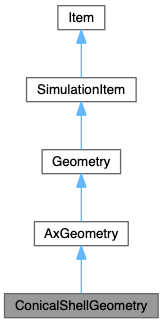
The ConicalShellGeometry class is a subclass of the AxGeometry class and describes the geometry of an axisymmetric conical shell which may be present, in addition to the torus, in the centre of active galactic nuclei (AGN). Very similar to the TorusGeometry, this geometry is described by a radial power-law density (see Stalevski et al. 2012, MNRAS, 420, 2756–2772) but with two finite opening angles, inner and outer. In formula, it is most easily expressed in spherical coordinates as
\[ \rho(r,\theta) = A\, r^{-p}\,{\text{e}}^{-q|\cos\theta|} \quad\text{for } r_{\text{min}}<r<r_{\text{max}} \text{ and } \frac{\pi}{2}-\Delta_{\text{out}} < \theta<\frac{\pi}{2}-\Delta_{\text{in}} \text{ and } \frac{\pi}{2}+\Delta_{\text{in}} < \theta<\frac{\pi}{2}+\Delta_{\text{out}}. \]
There are six free parameters describing this dust geometry: the inner and outer radii \(r_{\text{min}}\) and \(r_{\text{max}}\) of the conical shell, the radial power law index \(p\), the polar index \(q\) and the inner and outer opening angles \(\Delta_{\text{in}}\) and \(\Delta_{\text{out}}\) describing the inner and outer edge of the shell.
If the dusty system under consideration is in the vicinity of an AGN central engine or another source which is luminous enough to heat the dust up to sublimation temperature, the inner radius should correspond to sublimation radius and scale as \( r_{\text{min}} \propto L(\theta)^{0.5}\) (Barvainis, 1987, ApJ, 320, 537, eq (5)). If the primary source assumes anisotropic emission, the inner radius must follow the same dependence as the distribution of the primary source luminosity. Otherwise, dust temperature on the inner boundary of geometry is very likely to be under- or over-estimated. Thus, if the NetzerAccretionDiskGeometry distribution is chosen to describe primary source emission, it is recommended to turn on the anisotropic inner radius option for the torus geometry. The inner radius will then be set by the following formula:
\[ r_{\text{min}} \propto (\cos\theta\,(2\cos\theta+1))^{0.5}.\]
This should allow dust to approach all the way to the primary central source in the equatorial plane. However, due to the finite resolution of dust cells, it may happen that some of the innermost cells end up with unphysically high temperatures. For this reason, there is an additional input parameter, the cutoff radius \(r_{\text{cut}}\). The value of the cutoff radius is usually found after a few trial-and-error experiments by inspecting temperature distribution maps, until the inner wall of the geometry is at the expected sublimation temperature for a given dust population.
The total dust mass of the model corresponds to the mass of the original geometry, before the inner wall is reshaped to account for anisotropy; the difference is usually rather small.
This item type is displayed only if the Boolean expression "Level2" evaluates to true after replacing the names by true or false depending on their presence.
|
inlineprotected |
Default constructor for concrete Item subclass ConicalShellGeometry: "a conical shell geometry".
|
inline |
This function returns the value of the discoverable double property cutoffRadius: "the inner cutoff radius of the conical shell".
This property represents a physical quantity of type "length".
The minimum value for this property is "[0".
The default value for this property is given by the conditional value expression "0".
This property is relevant only if the Boolean expression "reshapeInnerRadius" evaluates to true after replacing the names by true or false depending on their presence.
|
overridevirtual |
This function returns the density \(\rho(R,z)\) at the cylindrical radius \(R\) and height \(z\). It just implements the analytical formula.
Implements AxGeometry.
|
inline |
This function returns the value of the discoverable double property exponent: "the radial powerlaw exponent p of the conical shell".
The minimum value for this property is "[0".
|
overridevirtual |
This function generates a random position from the torus geometry, by drawing a random point from the three-dimensional probability density \(p({\bf{r}})\, {\text{d}}{\bf{r}} = \rho({\bf{r}})\, {\text{d}}{\bf{r}}\). For the torus geometry, the density is a separable function of \(r\) and \(\theta\), so that a random position can hence be constructed by combining random spherical coordinates, each chosen from their own probability distributions. A random azimuth \(\phi\) is readily found by chosing a random deviate \({\cal{X}}\) and setting \( \phi = 2\pi {\cal{X}} \).
For the radial coordinate, the appropriate probability distribution is \(p(r)\,{\text{d}}r \propto r^{2-p}\,{\text{d}}r \). A random radius is generated by picking a new uniform deviate \({\cal{X}}\), and solving the equation
\[ {\cal{X}} = \int_{r_\text{min}}^r p(r')\, {\text{d}}r' \]
for \(r\). For \(p\ne3\) we find
\[{\cal{X}} = \frac{r^{3-p} - r_{\text{min}}^{3-p}} {r_{\text{max}}^{3-p} - r_{\text{min}}^{3-p}}. \]
Inverting this results in
\[ r = \left[ (1-{\cal{X}})\,r_{\text{min}}^{3-p} + {\cal{X}}\,r_{\text{max}}^{3-p} \right]^{\frac{1}{3-p}}. \]
For \(p=3\) this expression does not hold, and for \(p\approx3\) it breaks down numerically. So for \(p\approx3\) we can write the general expression
\[ r = {\text{gexp}}_{p-2} \Big[ {\text{gln}}_{p-2}\, r_{\text{min}} + {\cal{X}}\,( {\text{gln}}_{p-2}\, r_{\text{max}} - {\text{gln}}_{p-2}\, r_{\text{min}} ) \Bigr]. \]
In this expression, \({\text{gln}}_p\,x\) and \({\text{gexp}}_p\,x\) are the generalized logarithm and exponential functions defined in SpecialFunctions::gln and SpecialFunctions::gexp respectively.
Finally, for the polar angle, the appropriate distribution function is
\[ p(\theta)\, {\text{d}}\theta \propto e^{-q|\cos\theta|}\sin\theta\, {\text{d}}\theta. \]
A random polar angle is generated by picking a new uniform deviate \({\cal{X}}\), and solving the equation
\[ {\cal{X}} = \int_0^\theta p(\theta')\, {\text{d}}\theta' \]
for \(\theta\). We obtain after some calculation
\[ {\cal{X}} = \begin{cases} \; \dfrac12 \left( 1 - \dfrac{1-{\text{e}}^{-q\cos\theta}}{1-{\text{e}}^{-q\sin\Delta}} \right) & \quad\text{for } \frac{\pi}{2}-\Delta < \theta < \frac{\pi}{2} \\[1.2em] \;\dfrac12 \left( 1 + \dfrac{1-{\text{e}}^{q\cos\theta}}{1-{\text{e}}^{-q\sin\Delta}} \right) & \quad\text{for } \frac{\pi}{2} < \theta < \frac{\pi}{2}+\Delta \end{cases} \]
Inverting this gives
\[\cos\theta = \begin{cases}\; -\dfrac{1}{q} \ln\left[ 1-\left(1- {\text{e}}^{-q\sin\Delta}\right) (1-2{\cal{X}}) \right] & \quad\text{if $0<{\cal{X}}<\tfrac12$} \\[1.2em] \; \dfrac{1}{q} \ln\left[ 1-\left(1 -{\text{e}}^{-q\sin\Delta}\right) (2{\cal{X}}-1) \right] & \quad\text{if $\tfrac12<{\cal{X}}<1$} \end{cases}. \]
Since this function generates a random position from the torus geometry, positions are rejected until they fall into non-zere area, i.e. inside the conical shell.
Implements Geometry.
|
inline |
This function returns the value of the discoverable double property index: "the polar index q of the conical shell".
The minimum value for this property is "[0".
|
inline |
This function returns the value of the discoverable double property maxAngle: "the outer angle of the conical shell".
This property represents a physical quantity of type "posangle".
The minimum value for this property is "[0 deg".
The maximum value for this property is "90 deg]".
|
inline |
This function returns the value of the discoverable double property maxRadius: "the maximum radius of the conical shell".
This property represents a physical quantity of type "length".
The minimum value for this property is "]0".
|
inline |
This function returns the value of the discoverable double property minAngle: "the inner angle of the conical shell".
This property represents a physical quantity of type "posangle".
The minimum value for this property is "[0 deg".
The maximum value for this property is "90 deg]".
|
inline |
This function returns the value of the discoverable double property minRadius: "the minimum radius of the conical shell".
This property represents a physical quantity of type "length".
The minimum value for this property is "]0".
|
inline |
This function returns the value of the discoverable Boolean property reshapeInnerRadius: "reshape the inner radius according to the Netzer luminosity profile".
The default value for this property is given by the conditional value expression "false".
|
overrideprotectedvirtual |
This function verifies the validity of the geometry parameters. The normalization parameter \(A\) is set by the normalization condition that total mass equals one, i.e.
\[ 1 = 2\pi\, A\, 2\int_{\pi/2+\Delta_{\text{in}}}^{\pi/2+\Delta_{\text{out}}} e^{-q|\cos\theta|}\sin\theta\, {\text{d}}\theta \int_{r_{\text{min}}}^{r_{\text{max}}} r^{2-p}\, {\text{d}}r. \]
This results in
\[ A = \frac{q}{4\pi\, ({\text{e}}^{-q\sin\Delta_{\text{in}}} - {\text{e}}^{-q\sin\Delta_{\text{out}}})}\, \frac{1}{ {\text{gln}}_{p-2}\, r_{\text{max}} - {\text{gln}}_{p-2}\, r_{\text{min}} }, \]
with \({\text{gln}}_p\, x\) the generalized logarithm defined in SpecialFunctions::gln. If \(q=0\), this expression reduces to
\[ A = \frac{1}{4\pi\,(\sin\Delta_{\text{out}} - \sin\Delta_{\text{in}})\, ({\text{gln}}_{p-2}\, r_{\text{max}} - {\text{gln}}_{p-2}\, r_{\text{min}} )}. \]
Reimplemented from SimulationItem.
|
overridevirtual |
This function returns the radial surface density, i.e. the integration of the density along a line going through the conical shell, in the plane half way between inner and outer edge of the shell, starting at the centre of the coordinate system,
\[ \Sigma_R = \int_0^\infty \rho(r,\Delta)\,{\text{d}}r \quad\text{with}\quad \Delta=\frac{\Delta_{\text{in}} + \Delta_{\text{out}}}{2}. \]
For the conical shell geometry,
\[ \Sigma_R = A\, {\text{e}}^{-q\cos\Delta}\, ( {\text{gln}}_p\, r_{\text{max}} - {\text{gln}}_p\, r_{\text{min}} ) \]
with \({\text{gln}}_p\,x\) the generalized logarithm defined in SpecialFunctions::gln.
Implements AxGeometry.
|
overridevirtual |
This function returns the Z-axis surface density, i.e. the integration of the density along the entire Z-axis,
\[ \Sigma_Z = \int_{-\infty}^\infty \rho(0,0,z)\, {\text{d}}z. \]
For the conical shell geometry this integral is simply zero (we exclude the special limiting case where \(\Delta=\tfrac{\pi}{2}\)).
Implements Geometry.