 |
The SKIRT project
advanced radiative transfer for astrophysics
|
|
The SKIRT project
advanced radiative transfer for astrophysics
|
#include <FSPSSEDFamily.hpp>
Public Types | |
| enum class | IMF : int { Chabrier , Kroupa , Salpeter } |
Public Member Functions | |
| FSPSSEDFamily (SimulationItem *parent, IMF imf) | |
| double | cdf (Array &lambdav, Array &pv, Array &Pv, const Range &wavelengthRange, const Array ¶meters) const override |
| IMF | imf () const |
| Range | intrinsicWavelengthRange () const override |
| vector< SnapshotParameter > | parameterInfo () const override |
| double | specificLuminosity (double wavelength, const Array ¶meters) const override |
| Public Member Functions inherited from SimulationItem | |
| template<class T> | |
| T * | find (bool setup=true) const |
| template<class T> | |
| T * | interface (int upLevels, int downLevels, bool setup) const |
| virtual string | itemName () const |
| void | setup () |
| string | typeAndName () const |
| Public Member Functions inherited from Item | |
| Item (const Item &)=delete | |
| virtual | ~Item () |
| void | addChild (Item *child) |
| const vector< Item * > & | children () const |
| virtual void | clearItemListProperty (const PropertyDef *property) |
| void | destroyChild (Item *child) |
| virtual bool | getBoolProperty (const PropertyDef *property) const |
| virtual vector< double > | getDoubleListProperty (const PropertyDef *property) const |
| virtual double | getDoubleProperty (const PropertyDef *property) const |
| virtual string | getEnumProperty (const PropertyDef *property) const |
| virtual int | getIntProperty (const PropertyDef *property) const |
| virtual vector< Item * > | getItemListProperty (const PropertyDef *property) const |
| virtual Item * | getItemProperty (const PropertyDef *property) const |
| virtual string | getStringProperty (const PropertyDef *property) const |
| int | getUtilityProperty (string name) const |
| virtual void | insertIntoItemListProperty (const PropertyDef *property, int index, Item *item) |
| Item & | operator= (const Item &)=delete |
| Item * | parent () const |
| virtual void | removeFromItemListProperty (const PropertyDef *property, int index) |
| virtual void | setBoolProperty (const PropertyDef *property, bool value) |
| virtual void | setDoubleListProperty (const PropertyDef *property, vector< double > value) |
| virtual void | setDoubleProperty (const PropertyDef *property, double value) |
| virtual void | setEnumProperty (const PropertyDef *property, string value) |
| virtual void | setIntProperty (const PropertyDef *property, int value) |
| virtual void | setItemProperty (const PropertyDef *property, Item *item) |
| virtual void | setStringProperty (const PropertyDef *property, string value) |
| void | setUtilityProperty (string name, int value) |
| virtual string | type () const |
Protected Member Functions | |
| FSPSSEDFamily () | |
| void | setupSelfBefore () override |
| Protected Member Functions inherited from SEDFamily | |
| SEDFamily () | |
| Protected Member Functions inherited from SimulationItem | |
| SimulationItem () | |
| virtual bool | offersInterface (const std::type_info &interfaceTypeInfo) const |
| virtual void | setupSelfAfter () |
| Protected Member Functions inherited from Item | |
| Item () | |
Private Types | |
| using | BaseType |
| using | ItemType |
Private Attributes | |
| IMF | _imf |
| StoredTable< 3 > | _table |
Friends | |
| class | ItemRegistry |
An instance of the FSPSSEDFamily class represents a family of single stellar populations (SSPs) generated by the Flexible Stellar Population Synthesis (FSPS) code presented by Conroy, Gunn, & White (2009, ApJ, 699, 486) and Conroy & Gunn (2010, ApJ, 712, 833). The SED templates are parameterized on metallicity and age and scaled by the initial mass of the SSP.
We used the version of the FSPS code with git hash 182e2b4 committed on August 25, 2019, obtained from https://github.com/cconroy20/fsps. We did not make any changes to the code and its default compile-time and run-time configuration values. We created a custom main program to generate the output, overriding some of the run-time configuration values, including the choice of IMF. As a result, we generated SED families using the default MIST isochrones and the default MILES spectral libraries, for each of the Salpeter, Chabrier and Kroupa IMFs. We excluded dust attenuation and emission, as well as nebular emission. Otherwise, the default values are used for all parameters.
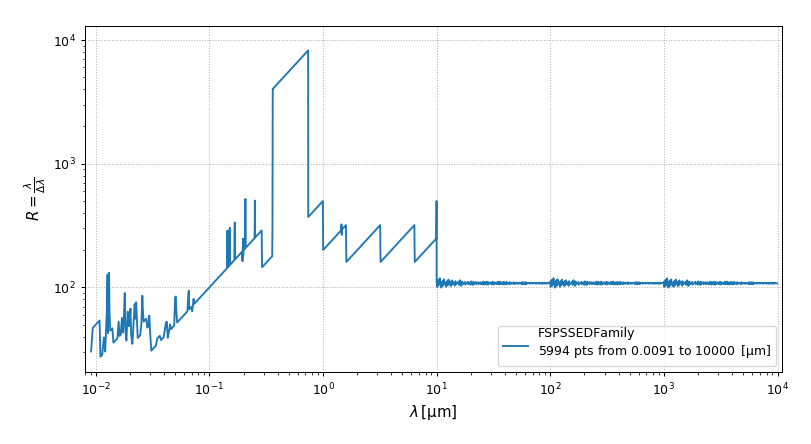
The SEDs are tabulated over a wavelength range from 0.009 \(\mu\mathrm{m}\) to 10000 \(\mu\mathrm{m}\) with the spectral resolution shown in the figure below.
When imported from a text column file, the parameters for this SED family must appear in the following order in the specified default units (unless these units are overridden by column header info):
\[ M_\mathrm{init}\,(\mathrm{M}_\odot) \quad Z\,(\mathrm{dimensionless}) \quad t\,(\mathrm{yr}) \]
|
strong |
The enumeration type indicating the assumed initial mass function (IMF).
Chabrier : "Chabrier IMF".
Kroupa : "Kroupa IMF".
Salpeter : "Salpeter IMF".
|
inlineprotected |
Default constructor for concrete Item subclass FSPSSEDFamily: "an FSPS SED family for single stellar populations".
|
explicit |
This constructor can be invoked programmatically by classes that use a hard-coded SED family (as opposed to selected through the ski file). Before the constructor returns, the newly created object is hooked up as a child to the specified parent in the simulation hierarchy (so it will automatically be deleted), and its setup() function has been called.
|
overridevirtual |
This function constructs both the normalized probability density function (pdf) and the corresponding normalized cumulative distribution function (cdf) for the SED with the specified parameters over the specified wavelength range. The function returns the normalization factor. The number and type of parameters must match the information returned by the parameterInfo() function; if not the behavior is undefined.
Implements SEDFamily.
|
inline |
This function returns the value of the discoverable IMF enumeration property imf: "the assumed initial mass function".
The default value for this property is given by the conditional value expression "Chabrier".
|
overridevirtual |
This function returns the intrinsic wavelength range of the SED family. It retrieves this range from the underlying stored table.
Implements SEDFamily.
|
overridevirtual |
This function returns the number and type of parameters used by this particular SED family as a list of SnapshotParameter objects. Each of these objects specifies unit information and a human-readable descripton for the parameter.
Implements SEDFamily.
|
overrideprotectedvirtual |
This function opens the appropriate resource file (in SKIRT stored table format).
Reimplemented from SimulationItem.
|
overridevirtual |
This function returns the specific luminosity \(L_\lambda\) (i.e. radiative power per unit of wavelength) for the SED with the specified parameters at the specified wavelength, or zero if the wavelength is outside of the SED's intrinsic wavelength range. The number and type of parameters must match the information returned by the parameterInfo() function; if not the behavior is undefined.
Implements SEDFamily.