 |
The SKIRT project
advanced radiative transfer for astrophysics
|
|
The SKIRT project
advanced radiative transfer for astrophysics
|
#include <MultiGaussianExpansionGeometry.hpp>
Public Member Functions | |
| double | density (double R, double z) const override |
| string | filename () const |
| Position | generatePosition () const override |
| double | inclination () const |
| double | pixelscale () const |
| double | SigmaR () const override |
| double | SigmaZ () const override |
| Public Member Functions inherited from AxGeometry | |
| double | density (Position bfr) const override |
| int | dimension () const override |
| double | SigmaX () const override |
| double | SigmaY () const override |
| Public Member Functions inherited from SimulationItem | |
| template<class T> | |
| T * | find (bool setup=true) const |
| template<class T> | |
| T * | interface (int upLevels, int downLevels, bool setup) const |
| virtual string | itemName () const |
| void | setup () |
| string | typeAndName () const |
| Public Member Functions inherited from Item | |
| Item (const Item &)=delete | |
| virtual | ~Item () |
| void | addChild (Item *child) |
| const vector< Item * > & | children () const |
| virtual void | clearItemListProperty (const PropertyDef *property) |
| void | destroyChild (Item *child) |
| virtual bool | getBoolProperty (const PropertyDef *property) const |
| virtual vector< double > | getDoubleListProperty (const PropertyDef *property) const |
| virtual double | getDoubleProperty (const PropertyDef *property) const |
| virtual string | getEnumProperty (const PropertyDef *property) const |
| virtual int | getIntProperty (const PropertyDef *property) const |
| virtual vector< Item * > | getItemListProperty (const PropertyDef *property) const |
| virtual Item * | getItemProperty (const PropertyDef *property) const |
| virtual string | getStringProperty (const PropertyDef *property) const |
| int | getUtilityProperty (string name) const |
| virtual void | insertIntoItemListProperty (const PropertyDef *property, int index, Item *item) |
| Item & | operator= (const Item &)=delete |
| Item * | parent () const |
| virtual void | removeFromItemListProperty (const PropertyDef *property, int index) |
| virtual void | setBoolProperty (const PropertyDef *property, bool value) |
| virtual void | setDoubleListProperty (const PropertyDef *property, vector< double > value) |
| virtual void | setDoubleProperty (const PropertyDef *property, double value) |
| virtual void | setEnumProperty (const PropertyDef *property, string value) |
| virtual void | setIntProperty (const PropertyDef *property, int value) |
| virtual void | setItemProperty (const PropertyDef *property, Item *item) |
| virtual void | setStringProperty (const PropertyDef *property, string value) |
| void | setUtilityProperty (string name, int value) |
| virtual string | type () const |
Protected Member Functions | |
| MultiGaussianExpansionGeometry () | |
| void | setupSelfBefore () override |
| Protected Member Functions inherited from AxGeometry | |
| AxGeometry () | |
| Protected Member Functions inherited from Geometry | |
| Geometry () | |
| Random * | random () const |
| Protected Member Functions inherited from SimulationItem | |
| SimulationItem () | |
| virtual bool | offersInterface (const std::type_info &interfaceTypeInfo) const |
| virtual void | setupSelfAfter () |
| Protected Member Functions inherited from Item | |
| Item () | |
Private Types | |
| using | BaseType |
| using | ItemType |
Private Attributes | |
| string | _filename |
| double | _inclination |
| Array | _Mcumv |
| Array | _Mv |
| int | _Ncomp |
| double | _pixelscale |
| Array | _qv |
| Array | _sigmav |
Friends | |
| class | ItemRegistry |
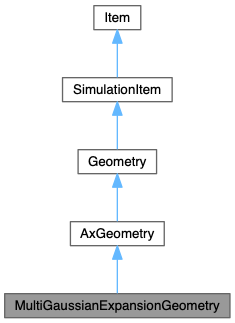
The MultiGaussianExpansionGeometry class is a subclass of the AxGeometry class, and describes axisymmetric geometries characterized by a combination of gaussian distributions in the radial and the vertical direction,
\[ \rho(R,z) = \sum_j\rho_{j,0}\,\exp\left( -\frac{R^2}{2\sigma_j^2} -\frac{z^2}{2q_j^2\sigma_j^2}\right) \]
Using a multi-gaussian expansion (MGE), one can reconstruct a large variety of geometries; see for example Emsellem, Monnet & Bacon (1994, A&A, 285, 723), Emsellem et al. (1994, A&A, 285, 739) and Cappellari (2002, MNRAS, 333, 400).
This item type is displayed only if the Boolean expression "Level2" evaluates to true after replacing the names by true or false depending on their presence.
|
inlineprotected |
Default constructor for concrete Item subclass MultiGaussianExpansionGeometry: "a multi-gaussian expansion geometry".
|
overridevirtual |
This function returns the density \(\rho(R,z)\) at the cylindrical radius \(R\) and height \(z\). It just sums the contribution of the different MGE components.
Implements AxGeometry.
|
inline |
This function returns the value of the discoverable string property filename: "the name of the file with the multi-gaussian expansion parameters".
|
overridevirtual |
This pure virtual function generates a random position from the geometry, by drawing a random point from the three-dimensional probability density \(p({\bf{r}})\, {\text{d}}{\bf{r}} = \rho({\bf{r}})\, {\text{d}}{\bf{r}}\). In the case of an MGE geometry, first a random component is chosen according to the discrete probability distribution \(p_j = M_j\). Once this component is selected, a random position \({\bf{r}} = (x,y,z)\) is generated by choosing three random numbers \((X_1,X_2,X_3)\) from a gaussian distribution and setting
\[ \begin{split} x &= \sigma_j\, X_1 \\ y &= \sigma_j \, X_2 \\ z &= q_j\, \sigma_j\, X_3 \end{split} \]
Implements Geometry.
|
inline |
This function returns the value of the discoverable double property inclination: "the inclination of the system".
This property represents a physical quantity of type "posangle".
The minimum value for this property is "[0".
The maximum value for this property is "90 deg]".
|
inline |
This function returns the value of the discoverable double property pixelscale: "the scale of the multi-gaussian-expanded image (length per pixel)".
This property represents a physical quantity of type "length".
The minimum value for this property is "]0".
|
overrideprotectedvirtual |
This function reads a file with the parameters obtained by performing a multi-gaussian expansion of an image on the sky. The file should contain three columns, with the first column the total count \(N_j\) of the \(j\)'th component, the second column the scalelength \(\sigma_j\) in pixel units and the third column the apparent flattening \(q'_j\) on the plane of the sky. Apart from this file, the function needs the physical pixel scale (e.g. in pc/pix) of the images that have been used for the MGE decomposition and the inclination of the system. From these data, the function calculates for each of the components the normalized mass contribution
\[ M_j = \frac{N_j}{\sum_{j'} N_{j'}}, \]
the scalelength \(\sigma_j\) in physical units and the actual flattening \(q_j\) of each of the components. In particular, the actual flattening is calculated from the apparent flattening and inclination of the system using the relation
\[ q_j = \frac{\sqrt{{q'}_j^2-\cos^2i}}{\sin i} \]
Reimplemented from Geometry.
|
overridevirtual |
This function returns the radial surface density, i.e. the integration of the density along a line in the equatorial plane starting at the centre of the coordinate system,
\[\Sigma_R = \int_0\infty \rho(R,0)\,{\text{d}}R. \]
For the MGE geometry we find
\[\Sigma_R = \sum_j \rho_{0,j} \int_0^\infty \exp\left(-\frac{R^2}{2\sigma_j^2}\right) {\text{d}}R = \frac{1}{4\pi} \sum_j \frac{M_j}{q_j\,\sigma_j^2}. \]
Implements AxGeometry.
|
overridevirtual |
This function returns the Z-axis surface density, i.e. the integration of the density along the entire Z-axis,
\[ \Sigma_Z = \int_{-\infty}^\infty \rho(0,0,z)\,{\text{d}}z. \]
For the MGE geometry we find
\[ \Sigma_Z = \sum_j \rho_{0,j} \int_{-\infty}^\infty \exp\left(-\frac{z^2}{2 q_j^2 \sigma_j^2}\right) {\text{d}}z = \frac{1}{2\pi} \sum_j \frac{M_j}{\sigma_j^2}. \]
Implements Geometry.