 |
The SKIRT project
advanced radiative transfer for astrophysics
|
|
The SKIRT project
advanced radiative transfer for astrophysics
|
#include <PseudoSersicGeometry.hpp>
Public Member Functions | |
| double | density (double r) const override |
| double | effectiveRadius () const |
| double | index () const |
| double | randomRadius () const override |
| double | Sigmar () const override |
| Public Member Functions inherited from SpheGeometry | |
| double | density (Position bfr) const override |
| int | dimension () const override |
| Position | generatePosition () const override |
| double | SigmaX () const override |
| double | SigmaY () const override |
| double | SigmaZ () const override |
| Public Member Functions inherited from SimulationItem | |
| template<class T> | |
| T * | find (bool setup=true) const |
| template<class T> | |
| T * | interface (int upLevels, int downLevels, bool setup) const |
| virtual string | itemName () const |
| void | setup () |
| string | typeAndName () const |
| Public Member Functions inherited from Item | |
| Item (const Item &)=delete | |
| virtual | ~Item () |
| void | addChild (Item *child) |
| const vector< Item * > & | children () const |
| virtual void | clearItemListProperty (const PropertyDef *property) |
| void | destroyChild (Item *child) |
| virtual bool | getBoolProperty (const PropertyDef *property) const |
| virtual vector< double > | getDoubleListProperty (const PropertyDef *property) const |
| virtual double | getDoubleProperty (const PropertyDef *property) const |
| virtual string | getEnumProperty (const PropertyDef *property) const |
| virtual int | getIntProperty (const PropertyDef *property) const |
| virtual vector< Item * > | getItemListProperty (const PropertyDef *property) const |
| virtual Item * | getItemProperty (const PropertyDef *property) const |
| virtual string | getStringProperty (const PropertyDef *property) const |
| int | getUtilityProperty (string name) const |
| virtual void | insertIntoItemListProperty (const PropertyDef *property, int index, Item *item) |
| Item & | operator= (const Item &)=delete |
| Item * | parent () const |
| virtual void | removeFromItemListProperty (const PropertyDef *property, int index) |
| virtual void | setBoolProperty (const PropertyDef *property, bool value) |
| virtual void | setDoubleListProperty (const PropertyDef *property, vector< double > value) |
| virtual void | setDoubleProperty (const PropertyDef *property, double value) |
| virtual void | setEnumProperty (const PropertyDef *property, string value) |
| virtual void | setIntProperty (const PropertyDef *property, int value) |
| virtual void | setItemProperty (const PropertyDef *property, Item *item) |
| virtual void | setStringProperty (const PropertyDef *property, string value) |
| void | setUtilityProperty (string name, int value) |
| virtual string | type () const |
Protected Member Functions | |
| PseudoSersicGeometry () | |
| void | setupSelfBefore () override |
| Protected Member Functions inherited from SpheGeometry | |
| SpheGeometry () | |
| Protected Member Functions inherited from Geometry | |
| Geometry () | |
| Random * | random () const |
| Protected Member Functions inherited from SimulationItem | |
| SimulationItem () | |
| virtual bool | offersInterface (const std::type_info &interfaceTypeInfo) const |
| virtual void | setupSelfAfter () |
| Protected Member Functions inherited from Item | |
| Item () | |
Private Types | |
| using | BaseType |
| using | ItemType |
Private Attributes | |
| double | _bn |
| double | _effectiveRadius |
| double | _index |
| const double & | _n |
| const double & | _reff |
| double | _rhon |
| Array | _rv |
| Array | _Xv |
Friends | |
| class | ItemRegistry |
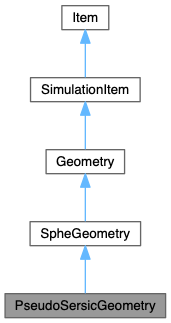
The PseudoSersicGeometry class is a subclass of the SpheGeometry class, and describes geometries that are a very good approximation of a Sersic density profile. This geometry, introduced by Prugniel & Simien (1997, A&A, 321,111) is an approximation of the Sersic geometry and has the advantage that the space density is known analytically rather than the density projected on the sky. The pseudo-Sersic geometry is characterized by the density profile,
\[ \rho(r) = \rho_n \left(\frac{r}{r_{\text{eff}}}\right)^{\frac{1}{2n}-1}\, \exp\left[-b_n\left(\frac{r}{r_{\text{eff}}}\right)^\frac{1}{n}\right]. \]
The parameter \(b_n\) is a dimensionless number given by
\[ b_n = 2n -\frac{1}{3} + \frac{4}{405n} + \frac{46}{25515n^2} + \frac{131}{1148175n^3}. \]
The geometry has two free parameters: the Sersic index \(n\) and the effective radius \(r_{\text{eff}}\).
This item type is displayed only if the Boolean expression "Level2" evaluates to true after replacing the names by true or false depending on their presence.
|
inlineprotected |
Default constructor for concrete Item subclass PseudoSersicGeometry: "a pseudo-Sérsic geometry".
|
overridevirtual |
This function returns the density \(\rho(r)\) at the radius \(r\). It just implements the analytical formula.
Implements SpheGeometry.
|
inline |
This function returns the value of the discoverable double property effectiveRadius: "the effective radius".
This property represents a physical quantity of type "length".
The minimum value for this property is "]0".
|
inline |
This function returns the value of the discoverable double property index: "the Sérsic index n".
The minimum value for this property is "]0.5".
The maximum value for this property is "10]".
The default value for this property is given by the conditional value expression "1".
|
overridevirtual |
This function returns the radius of a random position drawn from the pseudo-Sersic geometry. We just use the vector of cumulative masses stored internally.
Implements SpheGeometry.
|
overrideprotectedvirtual |
This function calculates some frequently used values. The density scale \(\rho_n\) is set by the normalization condition that the total mass is equal to one. We easily find that
\[ \rho_n = \frac{b_n^{2n+\frac12}}{4\pi\,r_{\text{eff}}^3\, n\, \Gamma(2n+\tfrac12)}. \]
We also set of a vector with the cumulative mass
\[ M(r) = 4\pi \int_0^r \rho(r')\, r'^2\, {\text{d}}r' \]
at a large number of radii. For the pseudo-Sersic model,
\[ M(r) = P\left[\frac12+2n,b_n\left(\frac{r}{r_{\text{e}}}\right)^{1/n}\right] \]
where \(P(a,x)\) is the incomplete Gamma function.
Reimplemented from Geometry.
|
overridevirtual |
This function returns the radial surface density, i.e. the integration of the density along a line starting at the centre of the coordinate system,
\[ \Sigma_r = \int_0^\infty \rho(r)\,{\text{d}}r. \]
For the pseudo-Sersic geometry, one finds
\[ \Sigma_r = \frac{\sqrt{\pi}\, n\, \rho_0\, r_{\text{eff}}}{\sqrt{b_n}}. \]
Implements SpheGeometry.