 |
The SKIRT project
advanced radiative transfer for astrophysics
|
|
The SKIRT project
advanced radiative transfer for astrophysics
|
#include <TTauriDiskGeometry.hpp>
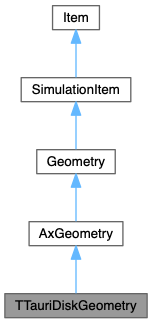
Public Member Functions | |
| double | density (double R, double z) const override |
| Position | generatePosition () const override |
| double | maxRadius () const |
| double | minRadius () const |
| double | radialIndex () const |
| double | scaleHeight () const |
| double | scaleLength () const |
| double | SigmaR () const override |
| double | SigmaZ () const override |
| double | verticalIndex () const |
| Public Member Functions inherited from AxGeometry | |
| double | density (Position bfr) const override |
| int | dimension () const override |
| double | SigmaX () const override |
| double | SigmaY () const override |
| Public Member Functions inherited from SimulationItem | |
| template<class T> | |
| T * | find (bool setup=true) const |
| template<class T> | |
| T * | interface (int upLevels, int downLevels, bool setup) const |
| virtual string | itemName () const |
| void | setup () |
| string | typeAndName () const |
| Public Member Functions inherited from Item | |
| Item (const Item &)=delete | |
| virtual | ~Item () |
| void | addChild (Item *child) |
| const vector< Item * > & | children () const |
| virtual void | clearItemListProperty (const PropertyDef *property) |
| void | destroyChild (Item *child) |
| virtual bool | getBoolProperty (const PropertyDef *property) const |
| virtual vector< double > | getDoubleListProperty (const PropertyDef *property) const |
| virtual double | getDoubleProperty (const PropertyDef *property) const |
| virtual string | getEnumProperty (const PropertyDef *property) const |
| virtual int | getIntProperty (const PropertyDef *property) const |
| virtual vector< Item * > | getItemListProperty (const PropertyDef *property) const |
| virtual Item * | getItemProperty (const PropertyDef *property) const |
| virtual string | getStringProperty (const PropertyDef *property) const |
| int | getUtilityProperty (string name) const |
| virtual void | insertIntoItemListProperty (const PropertyDef *property, int index, Item *item) |
| Item & | operator= (const Item &)=delete |
| Item * | parent () const |
| virtual void | removeFromItemListProperty (const PropertyDef *property, int index) |
| virtual void | setBoolProperty (const PropertyDef *property, bool value) |
| virtual void | setDoubleListProperty (const PropertyDef *property, vector< double > value) |
| virtual void | setDoubleProperty (const PropertyDef *property, double value) |
| virtual void | setEnumProperty (const PropertyDef *property, string value) |
| virtual void | setIntProperty (const PropertyDef *property, int value) |
| virtual void | setItemProperty (const PropertyDef *property, Item *item) |
| virtual void | setStringProperty (const PropertyDef *property, string value) |
| void | setUtilityProperty (string name, int value) |
| virtual string | type () const |
Protected Member Functions | |
| TTauriDiskGeometry () | |
| void | setupSelfBefore () override |
| Protected Member Functions inherited from AxGeometry | |
| AxGeometry () | |
| Protected Member Functions inherited from Geometry | |
| Geometry () | |
| Random * | random () const |
| Protected Member Functions inherited from SimulationItem | |
| SimulationItem () | |
| virtual bool | offersInterface (const std::type_info &interfaceTypeInfo) const |
| virtual void | setupSelfAfter () |
| Protected Member Functions inherited from Item | |
| Item () | |
Private Types | |
| using | BaseType |
| using | ItemType |
Friends | |
| class | ItemRegistry |
The TTauriDiskGeometry class describes the geometry of a typical passive disk around a T Tauri star. The disks are axisymmetric with a central cavity and are characterized by the density distribution
\[ \rho(R,z) = \rho_0 \left(\frac{R}{R_d}\right)^{-\alpha} \exp\left\{ -b \left[ \frac{z/z_d} {(R/R_d)^{9/8}} \right]^2 \right\} \qquad\qquad R_{\text{inn}} < R < R_{\text{out}}. \]
There are six parameters for this geometry: the exponent indices \(\alpha>0\) and \(b>0\), the inner and outer radii \(R_{\text{inn}}>0\) and \(R_{\text{out}}>R_{\text{inn}}\), and the scale length \(R_d>0\) and scale height \(z_d>0\).
Special cases of this geometry are used in the radiative transfer benchmark problems described by Pascucci et al. (2004, A&A, 417, 793) and Pinte et al. (2009, A&A, 498, 967).
Note: for the implementation of this geometry we use the generalized logarithm defined by SpecialFunctions::gln() and its inverse SpecialFunctions::gexp(). Specifically, we often use the difference function SpecialFunctions::gln2() defined as
\[ {\text{gln2}}(p,x_1,x_2) = {\text{gln}}(p,x_1) - {\text{gln}}(p,x_2) = \int_{x_2}^{x_1} t^{-p}\,{\text{d}}t. \]
This item type is displayed only if the Boolean expression "Level2" evaluates to true after replacing the names by true or false depending on their presence.
|
inlineprotected |
Default constructor for concrete Item subclass TTauriDiskGeometry: "a T Tauri disk geometry".
|
overridevirtual |
This function returns the density \(\rho(R,z)\) at the cylindrical radius \(R\) and height \(z\). It just implements the analytical formula.
Implements AxGeometry.
|
overridevirtual |
This function generates a random position from the geometry by drawing a random point from the three-dimensional probability density \(p({\bf{r}})\, {\text{d}}{\bf{r}} = \rho({\bf{r}})\, {\text{d}}{\bf{r}}\). In the present case, we accomplish this by picking a random cylindrical radius \(R\), a random height \(z\), and a random azimuth \(\phi\) from the appropriate one-dimensional probability distribution functions.
We first generate a random radius \(R\) from the marginal distribution
\[p(R)\,{\text{d}}R = 2\pi R\, {\text{d}}R\, \int_{-\infty}^\infty \rho(R,z)\, {\text{d}}z. \]
The cumulative distribution is
\[ P(R) = 2\pi\, \int_{R_\text{inn}}^R R'\,{\text{d}}R' \, \int_{-\infty}^\infty \rho(R',z)\,{\text{d}}z. \]
Using the definitions of gln() and gln2() noted in the class header, the cumulative distribution can be written as
\[ P(R) = \frac{\text{gln2}\left(\alpha-\frac{17}{8}, \frac{R}{R_d}, \frac{R_{\text{inn}}}{R_d}\right)} {\text{gln2}\left(\alpha-\frac{17}{8}, \frac{R_{\text{out}}}{R_d}, \frac{R_{\text{inn}}}{R_d}\right)} = \frac{\text{gln}\left(\alpha-\frac{17}{8}, \frac{R}{R_d}, \right) - \text{gln}\left(\alpha-\frac{17}{8}, \frac{R_{\text{inn}}}{R_d}\right)} {\text{gln2}\left(\alpha-\frac{17}{8}, \frac{R_{\text{out}}}{R_d}, \frac{R_{\text{inn}}}{R_d}\right)}. \]
A random \(R\) is generated by picking a uniform deviate \({\cal{X}}\) and setting \({\cal{X}}=P(R)\). After resolving for \(R\), and using the inverse generalized logarithm gexp(), we obtain
\[ R = R_d\, \text{gexp}\left[\alpha-\frac{17}{8}, \text{gln}\left(\alpha-\frac{17}{8}, \frac{R_{\text{inn}}}{R_d}\right) + {\cal{X}}\, \text{gln2}\left(\alpha-\frac{17}{8}, \frac{R_{\text{out}}}{R_d}, \frac{R_{\text{inn}}}{R_d}\right) \right]. \]
We then generate a random height from the conditional distribution function
\[p(z)\,{\text{d}}z = \dfrac{\rho(R,z)\,{\text{d}}z}{\int_{-\infty}^\infty \rho(R,z')\, {\text{d}}z'}, \]
where \(R\) is the random cylindrical radius generated before. One easily finds that this distribution is a Gaussian distribution with mean zero and dispersion
\[ \sigma(R) = \frac{1}{\sqrt{2b}}\,z_d\,\left(\frac{R}{R_d}\right)^{9/8}. \]
Generating a random \(z\) from this distribution is easy as the Random class contains a gaussian random number generating function.
Finally, we simply generate the azimuth from a uniform distribution between 0 and \(2\pi\).
Implements Geometry.
|
inline |
This function returns the value of the discoverable double property maxRadius: "the outer radius of the disk".
This property represents a physical quantity of type "length".
The minimum value for this property is "]0".
|
inline |
This function returns the value of the discoverable double property minRadius: "the inner radius of the disk".
This property represents a physical quantity of type "length".
The minimum value for this property is "]0".
|
inline |
This function returns the value of the discoverable double property radialIndex: "the radial exponent index α".
The minimum value for this property is "]0".
The default value for this property is given by the conditional value expression "2.5".
|
inline |
This function returns the value of the discoverable double property scaleHeight: "the scale height".
This property represents a physical quantity of type "length".
The minimum value for this property is "]0".
|
inline |
This function returns the value of the discoverable double property scaleLength: "the scale length".
This property represents a physical quantity of type "length".
The minimum value for this property is "]0".
|
overrideprotectedvirtual |
This function verifies that the parameters are valid and it calculates the normalization constant \(\rho_0\) determined by requiring that total mass equals one:
\[ 1 = 2\pi\, \int_{R_\text{inn}}^{R_\text{out}} R\,{\text{d}}R \, \int_{-\infty}^\infty \rho(R,z)\,{\text{d}}z. \]
Given that
\[ \int_{-\infty}^{+\infty} \exp(-a^2x^2)\,\text{d}x = \frac{\sqrt{\pi}}{a}, \]
and using the definition of gln2() noted in the class header, we find after some algebra that
\[ \rho_0 = \left[ 2\, \pi^{3/2}\, b^{-1/2}\, R_d^2\, z_d\, \text{gln2}\left(\alpha-\frac{17}{8}, \frac{R_{\text{out}}}{R_d}, \frac{R_{\text{inn}}}{R_d}\right) \right]^{-1}. \]
Reimplemented from Geometry.
|
overridevirtual |
This function returns the radial surface density, i.e. the integration of the density along a line in the equatorial plane starting at the centre of the coordinate system,
\[\Sigma_R = \int_0^\infty \rho(R,0)\,{\text{d}}R. \]
Using the definition of gln2() noted in the class header, we easily find for the T Tauri disk geometry that
\[ \Sigma_R = \rho_0\, R_d\, \text{gln2}\left( \alpha, \frac{R_{\text{out}}}{R_d}, \frac{R_{\text{inn}}}{R_d} \right). \]
Implements AxGeometry.
|
overridevirtual |
This function returns the vertical surface density, i.e. the integration of the density along the entire Z-axis,
\[ \Sigma_Z = \int_{-\infty}^\infty \rho(0,z)\, {\text{d}}z. \]
For the T Tauri disk geometry with its central cylindrical cavity, this integral is zero.
Implements Geometry.
|
inline |
This function returns the value of the discoverable double property verticalIndex: "the vertical exponent index b".
The minimum value for this property is "]0".
The default value for this property is given by the conditional value expression "0.5".