 |
The SKIRT project
advanced radiative transfer for astrophysics
|
|
The SKIRT project
advanced radiative transfer for astrophysics
|
#include <ExpDiskGeometry.hpp>
Public Member Functions | |
| double | maxRadius () const |
| double | maxZ () const |
| double | minRadius () const |
| double | scaleHeight () const |
| double | scaleLength () const |
| Public Member Functions inherited from SepAxGeometry | |
| Position | generatePosition () const override |
| Public Member Functions inherited from AxGeometry | |
| double | density (Position bfr) const override |
| int | dimension () const override |
| double | SigmaX () const override |
| double | SigmaY () const override |
| Public Member Functions inherited from SimulationItem | |
| template<class T> | |
| T * | find (bool setup=true) const |
| template<class T> | |
| T * | interface (int upLevels, int downLevels, bool setup) const |
| virtual string | itemName () const |
| void | setup () |
| string | typeAndName () const |
| Public Member Functions inherited from Item | |
| Item (const Item &)=delete | |
| virtual | ~Item () |
| void | addChild (Item *child) |
| const vector< Item * > & | children () const |
| virtual void | clearItemListProperty (const PropertyDef *property) |
| void | destroyChild (Item *child) |
| virtual bool | getBoolProperty (const PropertyDef *property) const |
| virtual vector< double > | getDoubleListProperty (const PropertyDef *property) const |
| virtual double | getDoubleProperty (const PropertyDef *property) const |
| virtual string | getEnumProperty (const PropertyDef *property) const |
| virtual int | getIntProperty (const PropertyDef *property) const |
| virtual vector< Item * > | getItemListProperty (const PropertyDef *property) const |
| virtual Item * | getItemProperty (const PropertyDef *property) const |
| virtual string | getStringProperty (const PropertyDef *property) const |
| int | getUtilityProperty (string name) const |
| virtual void | insertIntoItemListProperty (const PropertyDef *property, int index, Item *item) |
| Item & | operator= (const Item &)=delete |
| Item * | parent () const |
| virtual void | removeFromItemListProperty (const PropertyDef *property, int index) |
| virtual void | setBoolProperty (const PropertyDef *property, bool value) |
| virtual void | setDoubleListProperty (const PropertyDef *property, vector< double > value) |
| virtual void | setDoubleProperty (const PropertyDef *property, double value) |
| virtual void | setEnumProperty (const PropertyDef *property, string value) |
| virtual void | setIntProperty (const PropertyDef *property, int value) |
| virtual void | setItemProperty (const PropertyDef *property, Item *item) |
| virtual void | setStringProperty (const PropertyDef *property, string value) |
| void | setUtilityProperty (string name, int value) |
| virtual string | type () const |
Protected Member Functions | |
| ExpDiskGeometry () | |
| double | density (double R, double z) const override |
| double | randomCylRadius () const override |
| double | randomZ () const override |
| void | setupSelfBefore () override |
| double | SigmaR () const override |
| double | SigmaZ () const override |
| Protected Member Functions inherited from SepAxGeometry | |
| SepAxGeometry () | |
| Protected Member Functions inherited from AxGeometry | |
| AxGeometry () | |
| Protected Member Functions inherited from Geometry | |
| Geometry () | |
| Random * | random () const |
| void | setupSelfBefore () override |
| Protected Member Functions inherited from SimulationItem | |
| SimulationItem () | |
| virtual bool | offersInterface (const std::type_info &interfaceTypeInfo) const |
| virtual void | setupSelfAfter () |
| Protected Member Functions inherited from Item | |
| Item () | |
Private Types | |
| using | BaseType |
| using | ItemType |
Friends | |
| class | ItemRegistry |
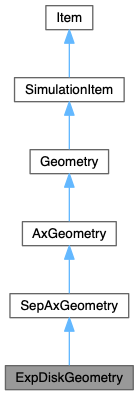
The ExpDiskGeometry class is a subclass of the SepAxGeometry class, and describes axisymmetric geometries characterized by a double-exponential profile, in which the density decreases exponentially in the radial and the vertical directions; see van der Kruit (1986, A&A, 157, 230–244). A truncation can be applied in both the radial and vertical direction, and an inner cylindrical hole can be included. In formula form
\[ \rho(R,z) = \rho_0\, {\text{e}}^{-\frac{R}{h_R}-\frac{|z|}{h_z}}, \]
for \(R_{\text{min}} \leq R \leq R_{\text{max}}\) and \(|z|\leq z_{\text{max}}\). The model contains five free parameters: the scale length \(h_R\), the vertical scale height \(h_z\), the radial truncation radius \(R_{\text{max}}\), the vertical truncation radius \(z_{\text{max}}\), and the inner radius \(R_{\text{min}}\).
|
inlineprotected |
Default constructor for concrete Item subclass ExpDiskGeometry: "an exponential disk geometry".
|
overrideprotectedvirtual |
This function returns the density \(\rho(R,z)\) at the cylindrical radius \(R\) and height \(z\). It just implements the analytical formula.
Implements AxGeometry.
|
inline |
This function returns the value of the discoverable double property maxRadius: "the truncation radius (zero means no truncation)".
This property represents a physical quantity of type "length".
The minimum value for this property is "[0".
The default value for this property is given by the conditional value expression "0".
This property is displayed only if the Boolean expression "Level2" evaluates to true after replacing the names by true or false depending on their presence.
|
inline |
This function returns the value of the discoverable double property maxZ: "the truncation height (zero means no truncation)".
This property represents a physical quantity of type "length".
The minimum value for this property is "[0".
The default value for this property is given by the conditional value expression "0".
This property is displayed only if the Boolean expression "Level2" evaluates to true after replacing the names by true or false depending on their presence.
|
inline |
This function returns the value of the discoverable double property minRadius: "the radius of the central cavity".
This property represents a physical quantity of type "length".
The minimum value for this property is "[0".
The default value for this property is given by the conditional value expression "0".
|
overrideprotectedvirtual |
This function returns the cylindrical radius \(R\) of a random position drawn from the geometry, by picking a uniform deviate \({\cal{X}}\) and solving the equation
\[{\cal{X}} = 2\pi \int_0^R \rho_R(R')\, R'\, {\text{d}}R' \]
for \(R\). Substituting the exponential radial profile (without truncation) into this equation, we obtain
\[ {\cal{X}} = 1 - \left( 1+\frac{R}{h_R} \right) \exp \left( -\frac{R}{h_R} \right). \]
This equation can be solved by means of the Lambert function of order \(-1\), yielding
\[ R = h_R \left[ -1-W_{-1} \left( \frac{ {\cal{X}}-1}{\text{e}} \right) \right]. \]
The Lambert function \(W_{-1}(z)\) is implemented in the function SpecialFunctions::LambertW1. The truncation and the inner hole are taken into account by rejecting values larger than \(R_{\text{max}}\) or smaller than \(R_{\text{min}}\).
Implements SepAxGeometry.
|
overrideprotectedvirtual |
This function returns the height \(z\) of a random position drawn from the geometry, by picking a uniform deviate \({\cal{X}}\) and solving the equation
\[ {\cal{X}} = \int_{-\infty}^z \rho_z(z')\, {\text{d}}z' \]
for \(z\). For the exponential disk geometry, this integration is simple, and the inversion results in
\[ z = \begin{cases} \; h_z\,\ln(2{\cal{X}}) & \text{if $0<{\cal{X}}<\tfrac{1}{2}$,} \\ \;-h_z\,\ln[2(1-{\cal{X}})] & \text{if $\tfrac{1}{2}<{\cal{X}}<1$.} \end{cases} \]
The truncation is taken into account by rejecting values \(|z|\) larger than \(z_{\text{max}}\).
Implements SepAxGeometry.
|
inline |
This function returns the value of the discoverable double property scaleHeight: "the scale height".
This property represents a physical quantity of type "length".
The minimum value for this property is "]0".
|
inline |
This function returns the value of the discoverable double property scaleLength: "the scale length".
This property represents a physical quantity of type "length".
The minimum value for this property is "]0".
|
overrideprotectedvirtual |
This function verifies the validity of the parameters. The central density \(\rho_0\) is set by the normalization condition that the total mass equals one. One finds after some elementary calculus
\[ \frac{1}{\rho_0} = 4\pi\, h_R^2\, h_z \left( 1 - {\text{e}}^{-z_{\text{max}}/h_z} \right) \left[ \left( 1+\frac{R_{\text{min}}}{h_R} \right) {\text{e}}^{-R_{\text{min}}/h_R}- \left( 1+\frac{R_{\text{max}}}{h_R} \right) {\text{e}}^{-R_{\text{max}}/h_R} \right] . \]
In case there is no truncation in either radial or vertical directions and no inner hole, this reduces to
\[ \rho_0 = \frac{1}{ 4\pi\, h_R^2\, h_z }. \]
Reimplemented from SimulationItem.
|
overrideprotectedvirtual |
This function returns the surface density along a line in the equatorial plane starting at the centre of the coordinate system, i.e.
\[ \Sigma_R = \int_0\infty \rho(R,0)\, {\text{d}}R. \]
For the exponential disc geometry we find
\[ \Sigma_R = \rho_0 h_R \left( {\text{e}}^{-R_{\text{min}}/h_R} - {\text{e}}^{-R_{\text{max}}/h_R} \right), \]
which reduces to \( \Sigma_R = \rho_0 h_R \) if there is no radial truncation and no inner hole.
Implements AxGeometry.
|
overrideprotectedvirtual |
This function returns the surface density along the Z-axis, i.e. the integration of the density along the entire Z-axis,
\[ \Sigma_Z = \int_{-\infty}^\infty \rho(0,0,z)\, {\text{d}}z.\]
For the exponential disc geometry we find
\[ \Sigma_Z = 2\,\rho_0 h_Z \left( 1 - {\text{e}}^{-z_{\text{max}}/h_z} \right), \]
which reduces to \( \Sigma_Z = 2\,\rho_0 h_z \) if there is no vertical truncation. If there is an inner hole, obviously \(\Sigma_Z=0\).
Implements Geometry.